


 BACK
BACKAmerica at 250: Breaking Ground
 June 29, 2026 - For more than a century, Freeport has helped supply the materials that built the nation and powered its growth, from early infrastructure projects to modern manufacturing and energy systems.
Today, the company is building on that legacy while helping shape the future of mining.
Understanding where the next major technological advances are emerging is critical to ensuring Freeport can take advantage of them, said Bert Odinet, Senior Vice President and Chief Innovation Officer. One example is artificial intelligence, where global spending reached nearly $1.5 trillion in 2025 and continues to grow. For Freeport, it’s one signal among many that technology will play an increasingly important role in positioning the company for the future.
“Our entire business is interrelated,” Odinet said. “From supply chain and finance to trucks and shovels to crushers and SXEW plants, having all those systems available for analytics and AI is going to be critical in advancing our business. Having that base foundation is something that we’ve worked on for the better part of a decade.”
The issue isn’t whether people can do the job but whether they can do it with the speed, scale and efficiency AI makes possible, Odinet said.
He pointed to systems that monitor truck performance in real time, where AI can analyze data, identify potential maintenance issues, assess their urgency and trigger the appropriate response – sometimes immediately.
The Integrated Remote Operations Center, or IROC, is another step toward that goal, creating a more standardized approach to monitoring, data analysis and response across the company. The new Phoenix-based facility also gives AI a clearer view into Freeport’s operating standards and priorities, helping to shape future strategies and decision-making.
Laying the Groundwork
Of course, while the company has an eye on the future, some of the biggest changes are occurring here and now.
With the Reinvent Mining initiative, Steven Bradbury, Director-Operations Strategy, said that the company already is rethinking and rebuilding how Freeport operates from the ground up to address modern challenges.
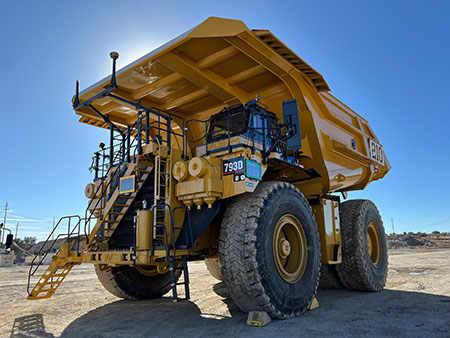
 One example is the company's effort to be more strategic about energy use, whether that's incorporating the more efficient diesel-electric, ultra-class haul trucks at Morenci or the battery-electric prototype haul truck at Sierrita.
For Bradbury, though, that's only the beginning.
While electric vehicles have become commonplace in the consumer space, their use in large-scale mining has lagged – but that gap is beginning to close. Haulage operations could see some of the industry’s biggest advances, including dynamic energy transfer systems that can charge battery-electric and diesel-electric haul trucks while they operate. Freeport also is evaluating in-pit crush and convey systems already used in South America for potential application in North America.
Combined with the company’s expanding energy generation initiatives, broader electrification could give Freeport greater control over costs that traditionally have been driven by external factors, including fuel.
Familiar Challenges, New Tools
Ore grades and their variability also are factors largely outside Freeport’s control, but advances in sensor technology are helping reduce their impact. Equipment across the value chain, from shovel buckets to processing circuits, is generating increasingly precise, real-time data on material characteristics, allowing teams to make faster, more informed processing decisions and respond to exceptions more quickly.
Coupled with automation – such as the fully autonomous trucks implemented in Bagdad – those capabilities can reduce inefficiencies that cause unit costs to rise, Bradbury said.
Like Odinet, Bradbury points to the advantage of an interconnected system. One day, there might be sensors on autonomous trucks that create detailed, real-time maps of road conditions and trigger automated support equipment to be dispatched to maintain them before the situation deteriorates.
“This is about more than adopting individual technologies,” Bradbury said. “It's an opportunity to rethink how we operate end-to-end and build a better understanding of the critical role our employees play in that equation. We have to upskill our workforce and reimagine our operating strategies to really leverage these new technologies and remain competitive.”
At the same time, the market itself is evolving rapidly in fundamental ways.
Demand for copper is being reshaped by forces significantly different from those that defined previous cycles, said Randy Nickel, Senior Vice President-Sales and Marketing. While traditional drivers such as construction, manufacturing and automotive remain important, growing demand increasingly is driven by long-term, transformational investments shaped by policy decisions and supported by few near-term substitutes.
“We're seeing a fundamental shift in how copper is viewed, as demand is no longer driven primarily by short-term economic cycles,” Nickle said. “It's being shaped by long duration investments in electrification, energy security and digital infrastructure. Copper is becoming a strategic material, and companies that can reliably deliver it are going to play a critical role in building the future.”
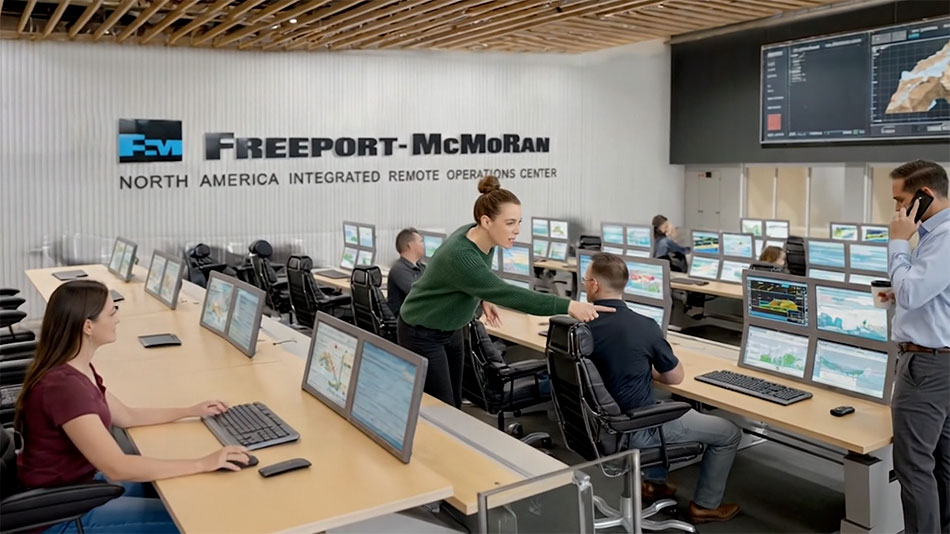
Photo (top to bottom): At Bagdad, a fleet of autonomous haul trucks is helping Freeport advance mining innovation; the electric haul trucks being piloted at Sierrita and other electrification projects can give the sites greater control over their energy costs; the new Integrated Remote Operations Center allows Freeport to standardize operational monitoring and response.



© 2026 Freeport-McMoRan
SOCIAL
RECOGNITION